
Contact us: 01147069953 contact@gigawatt.co.uk
AC Charging Infrastructure


Convenient, simple, efficient
charging for commercial, workplace and public spaces.
Who benefits from AC Charging?

Destinations and Retail
Attract more customers, increase time spent and stand out from other businesses

Public and Local Authority
Build a premium experience and encourage longer stays

Workplace
Support EV adoption, reduce costs and demonstrate commitment to sustainability
Why Choose DC Charging?
Simple Intergration
Works seamlessly with existing electrical networks without requiring complex grid reinforcements. Compatible with most home/workplace energy management systems.
Cost Effective Infrastructure
AC chargers are cheaper to purchase and install. Lower upfront investment makes them ideal for smaller businesses or residential developments.
Ideal for Dwell-Time Locations
Best suited for places where vehicles remain parked for longer periods, such as offices and workplaces, Residential, car parks, hotels and resorts, and long-stay public parking.
Flexible Scalability
Easier to deploy multiple AC charge points without major infrastructure upgrades. Ideal for apartment complexes, workplaces, and retail parks looking to offer multiple bays.
Cost Effective Infrastructure
AC chargers are cheaper to purchase and install. Lower upfront investment makes them ideal for smaller businesses or residential developments.
Ideal for Dwell-Time Locations
Best suited for places where vehicles remain parked for longer periods, such as Offices and workplaces, Residential, car parks, Hotels and resorts, and Long-stay public parking.
Flexible Scalability
Easier to deploy multiple AC charge points without major infrastructure upgrades. Ideal for apartment complexes, workplaces, and retail parks looking to offer multiple bays.
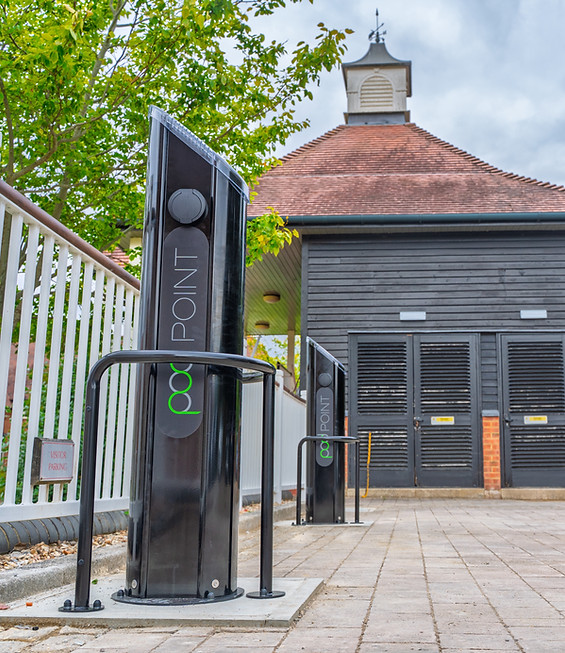
How AC Charging Works
AC (Alternating Current) charging is the most common way to charge electric vehicles, ideal for workplaces, homes, and destinations where vehicles are parked for longer periods.
Power Supply
Electricity is drawn from the local grid and delivered to the charger at standard voltages (usually single-phase 7kW or three-phase 22kW for faster charging).
Onboard Conversion
Unlike DC charging, the conversion to Direct Current happens inside the vehicle. The EV’s onboard charger converts the alternating current from the station into direct current suitable for the battery.
Controlled Charging
The charging unit communicates with the vehicle to regulate voltage, current, and charging speed. This ensures the battery is charged safely and efficiently without overloading the grid connection.
Typical Charging Times
7kW Charger 20–30 miles of range per hour of charge.
22kW Charger 60–90 miles of range per hour (vehicle dependent).
AC charging is slower than DC, but perfectly suited to overnight, workplace, or long-stay charging.
Our AC Charging Services

Consultation & Site Assessment
Design & Specification
Installation & Commissioning
Network Integration & Management
Maintenance & Support
Detailed analysis of your site’s power capacity, traffic flow, and user demand
Guidance on funding opportunities, grants, and ROI potential
Creation of a custom charging solution aligned with your infrastructure
Integration with your existing systems and future-proof layouts
Full civils, electrical, and groundwork delivered by our expert installation team
Safe, compliant installation adhering to all UK standards and regulations
Comprehensive testing and commissioning to ensure seamless operation
Smart charging solutions with remote monitoring and user management
Scalable options to grow as EV demand increases
Proactive maintenance to ensure maximum uptime and reliability
24/7 monitoring and rapid response from our dedicated support team
Ongoing software updates and lifecycle management


